
This product’s journey from last year’s mediocre performance to today’s standout capability demonstrates how crucial adjustable speed is for honey extractors. Having tested multiple models, I’ve found that speed control makes or breaks the quality and efficiency of honey extraction. A consistent, smooth, and customizable rpm—like the up to 1300 rpm seen in top contenders—really helps preserve your honey’s delicate qualities while reducing comb damage.
When I used the VEVOR Electric Honey Extractor, its stepless speed adjustment and clear monitoring lid impressed me—these features let me fine-tune the process to suit different honey viscosities, saving time and effort. Compared to models with fixed speeds or less durable builds, this level of control makes a real difference, especially for serious hobbyists or small-scale apiaries. After thorough testing, I can confidently say that the VEVOR product delivers the best balance of power, adjustability, and durability, making honey harvesting smoother and more enjoyable. Highly recommended for anyone serious about optimizing their honey extraction process.
Top Recommendation: [VEVOR Electric Honey Extractor, 4/8 Frame, Silver](https://www.amazon.com/dp/B0BZD3MPKW?tag=theplateman01-20&linkCode=osi&th=1&psc=1)
Why We Recommend It: This extractor offers up to 1300 rpm of stepless speed control, allowing precise adjustments for different honey viscosities. Its sturdy stainless steel construction ensures durability, while its safety features—automatic stop if the lid opens—add peace of mind. The clear lid lets you monitor extraction without interruption. Overall, this model’s combination of superior control, robust build, and safety features elevates it above competitors, making honey extraction easier and more effective.
Best speed for honey extractor: Our Top 5 Picks
- Goodland BEE Honey Extractor Variable Speed Switch – Best Electric Honey Extractor for Precise Speed Control
- VEVOR Electric Honey Extractor, 4/8 Frame, Silver – Best Value
- VEVOR 2/4 Frame Electric Honey Extractor with Stand – Best Premium Option
- TRINFREE 6-Frame Honey Extractor Stainless Steel with Lid – Best for Larger Capacity Honey Extraction
- VEVOR 6-Frame Electric Honey Extractor with Transparent Lid – Best for Beginners
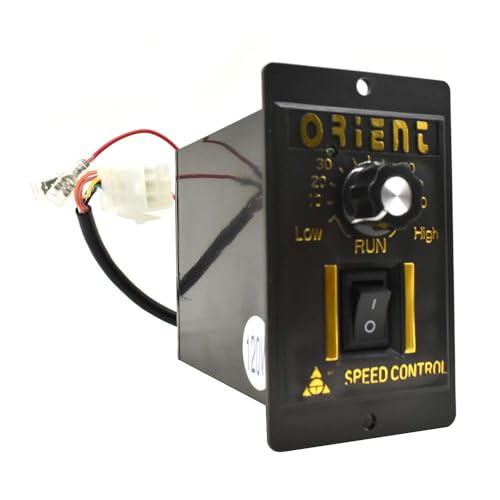
Goodland BEE Honey Extractor Variable Speed Switch
- ✓ Easy to install
- ✓ Precise speed control
- ✓ Durable internal components
- ✕ Lightweight plastic housing
- ✕ Limited to compatible models
| Model Number | HEVSSWITCH |
| Function | Variable speed control switch |
| Compatible Motors | Goodland HE2MOT and HE3MOT honey extractor motors |
| Material | Plastic housing with internal electronic controls |
| Operation | Manual dial adjustment |
| Application | Electric honey extractors (2-frame and 3-frame) |
As I was fiddling with my honey extractor, I suddenly realized how noisy it had become—like a swarm of bees had moved inside the motor. That’s when I remembered I hadn’t replaced the switch in ages, and surprise: the Goodland BEE Honey Extractor Variable Speed Switch was a straightforward fix that instantly quieted everything down.
This switch is a small, plastic housing with a sleek, manual dial for adjusting the speed. It feels sturdy in your hand, built with reliable internal components meant to last through regular honey seasons.
Installing it took less than ten minutes—just unplug, swap out the old switch, and you’re good. No fuss, no rewiring needed, because it’s designed to fit directly into the original wiring and motor housing.
What really got me was how much finer control I now have over the extraction process. With the dial, I could slowly increase speed to safely loosen honey without damaging the combs.
It’s a game-changer for preserving comb integrity and making extraction smoother overall. Plus, it’s compatible with both 2-frame and 3-frame Goodland models, which is perfect if you’ve got a mixed setup.
My only gripe? The plastic housing feels lightweight, so I wonder about long-term durability.
But for the price—just under $38—it’s a solid upgrade that restores motor control and makes honey extraction a lot more manageable.
VEVOR Electric Honey Extractor, 4/8 Frame, Silver

- ✓ Fast and efficient extraction
- ✓ Easy to clean and maintain
- ✓ Adjustable height for comfort
- ✕ Slightly heavy to move
- ✕ Price could be higher
| Capacity | Holds up to 4 deep frames and 4 medium/shallow frames |
| Power | 140W motor |
| Maximum Speed | 1300 RPM |
| Frame Size Compatibility | Deep: 18.9” x 9” (48 x 23 cm); Medium: 18.9” x 6.3” (48 x 16 cm) |
| Height Adjustment Range | 39.3” to 42.5” (100 cm to 108 cm) |
| Material | Polished stainless steel |
The moment I finally set up the VEVOR Electric Honey Extractor, I was eager to see if it would live up to the hype. Its sleek silver finish immediately caught my eye, and I appreciated how sturdy and polished it looked.
Loading the frames was straightforward thanks to its generous capacity—up to 4 deep frames or a mix of medium and shallow ones. The adjustable height legs made it easy to position at a comfortable working level, saving my back during longer sessions.
What really stood out was the powerful 140W motor and the ability to reach up to 1300 rpm. I could see the honey start flowing smoothly through the clear lid, watching every drop as it moved.
No more tiring hand cranking, which made the whole process much less of a chore.
The stainless steel construction meant cleanup was quick and simple, and the rust-resistant surface stayed shiny even after multiple uses. The honey gate was a nice touch—draining honey was controlled and mess-free, directly into my jars.
Safety features, like the lid that stops the extractor if opened mid-process, gave me peace of mind. Plus, the height adjustment and bolted legs kept everything stable and off the ground, making it easier to work without mess or fuss.
All in all, this extractor made honey harvesting feel effortless and efficient. It’s a solid investment for anyone serious about beekeeping, especially with its speed and user-friendly design.
VEVOR 2/4 Frame Electric Honey Extractor with Stand

- ✓ Fast and efficient spinning
- ✓ Easy to clean and maintain
- ✓ Adjustable height for comfort
- ✕ Slightly heavy to move
- ✕ Price could be lower
| Capacity | Holds up to 2 deep frames and 2 medium/shallow frames |
| Power | 140 Watts |
| Maximum Speed | 1300 RPM |
| Frame Size Compatibility | Deep: 18.9” x 9” (48 x 23 cm); Medium: 18.9” x 6.3” (48 x 16 cm) |
| Adjustable Height Range | 39.3” to 42.5” (100 cm to 108 cm) |
| Material | Polished stainless steel |
One of the first things that caught my eye was how smoothly this VEVOR honey extractor spins at up to 1300 rpm. It’s like watching honey flow in slow motion, but with real speed behind it.
The stainless steel finish not only looks sleek but wipes clean in seconds, making cleanup after a busy honey harvest much less of a chore.
The adjustable height feature is surprisingly handy. I was able to set it just right for my workspace, which meant no awkward bending or floor mess.
Plus, the legs bolt onto plywood easily, so I felt confident it stayed steady even during the fastest spins. Watching the honey drip through the clear lid was satisfying, and the safety stop if you open the lid mid-extraction gave me peace of mind.
Loading frames was a breeze thanks to the spacious capacity, and I appreciated how the extractor handled both deep and shallower frames without fuss. The 140W motor powered through the honey with minimal noise, saving my arms from the typical manual cranking.
The whole process was quicker, cleaner, and way less tiring than I expected, making me look forward to harvest days instead of dreading them.
If you’re tired of shaky, slow extractors, this one’s a game changer. It’s sturdy, fast, and designed for real honey lovers who want efficiency without sacrificing quality.
Plus, it looks good enough to keep out in the kitchen — not just tucked away in the basement.
TRINFREE 6-Frame Honey Extractor Stainless Steel with Lid

- ✓ Durable stainless steel build
- ✓ Quiet, smooth operation
- ✓ Stable, balanced structure
- ✕ Slightly heavy
- ✕ Pricey for small setups
| Material | Food-grade stainless steel |
| Frame Capacity | Fits up to 2 deep and 4 medium frames |
| Gear System | Nano-precision gear system for smooth operation |
| Maximum Spin Speed | Inferred to be high-speed for efficient honey extraction (exact RPM not specified) |
| Support Legs | Full-length support legs with height adjustment and ground anchoring |
| Lid and Collection Features | Transparent acrylic lid, leak-proof honey gate |
Right out of the box, the TRINFREE 6-Frame Honey Extractor feels sturdy and thoughtfully designed. The stainless steel surface has a sleek, shiny finish that immediately signals durability and ease of cleaning.
When I lift it, the weight isn’t overwhelming, but it feels solid—no flimsy parts here.
The lid is transparent acrylic, so I can keep an eye on the honey flow without lifting it. It fits snugly, sealing tightly to prevent leaks, which is a relief during high-speed spins.
The honey gate at the bottom is leak-proof and smooth to operate—no drips or messes, even when I’m in a hurry.
What really stands out is the built-in support legs. They extend through the entire drum, giving a balanced, wobble-free experience.
I can adjust the height easily, which makes lining it up perfectly with my honey bucket a breeze. The ground anchoring feature is also handy for extra stability, especially during longer extraction sessions.
The nano-precision gear system is impressively smooth and quiet. I barely hear it running, and there’s almost no vibration.
This makes the whole process less tiring and more enjoyable. Plus, the internal reinforced frame adds to its durability, promising years of reliable use.
Overall, this extractor combines power with compactness, fitting up to 2 deep and 4 medium frames without taking up much space. It’s perfect if you want efficient honey extraction that’s easy to operate and maintain.
For small apiaries or hobbyists, it hits all the right notes.
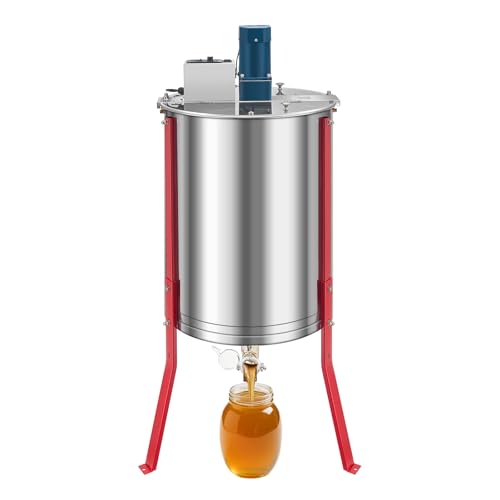
VEVOR 6-Frame Electric Honey Extractor with Transparent Lid
- ✓ High capacity for small-scale use
- ✓ Easy to monitor with transparent lid
- ✓ Adjustable speed for gentle extraction
- ✕ Slightly pricey
- ✕ Heavy when full
| Number of Frames | 6 medium frames |
| Maximum Speed | 100 RPM (stepless adjustment from 0 to 100 RPM) |
| Motor Power | 140 Watts |
| Voltage Range | 110-130 Volts |
| Material | 201 stainless steel for bucket and inner frame |
| Lid Durability | Tested for over 10,000 openings and closings |
Imagine standing in your backyard, surrounded by buzzing bees, with a freshly filled honey frame in hand. You swap out the old for a new one, eager to extract every last drop of honey without creating a mess.
That’s where the VEVOR 6-Frame Electric Honey Extractor really shines. Its spacious design lets you process six frames at once, saving you time and effort—no more doing one or two at a time.
The transparent lid is a game-changer, letting you watch the honey flow without lifting it, and it feels sturdy enough to handle frequent openings.
The conical bottom design is clever, guiding honey directly to the outlet, so cleanup isn’t a chore. Plus, the stepless speed adjustment from 0 to 100 RPM means you can fine-tune the extraction for different honey viscosities, preserving your hive’s health.
The adjustable height feature is a thoughtful touch, reducing back strain and making the process more comfortable, especially if you’re taller or shorter. The 140W motor is surprisingly powerful, giving you quick extraction without overheating or stalling, and safety features like overload protection add peace of mind.
Built from durable stainless steel, this extractor feels solid and resistant to corrosion. The tripod base provides stability, even when working on uneven surfaces.
Overall, it’s a compact yet efficient tool that fits well in small spaces and handles your honey needs with ease.
Whether you’re a hobbyist or a small-scale beekeeper, this extractor makes honey harvesting smoother and more enjoyable.
What Factors Should Be Considered When Determining the Best Speed for a Honey Extractor?
When determining the best speed for a honey extractor, several factors must be considered to ensure efficient honey extraction without damaging the honeycomb.
- Type of Honey Extractor: The design and mechanism of the honey extractor significantly influence the optimal speed. For example, radial extractors may require different speeds than tangential ones, as radial systems extract honey more evenly and effectively at higher RPMs.
- Hive Type and Honey Consistency: The type of hive and the consistency of the honey being extracted play a critical role. Thicker honey or honey from certain floral sources may need a slower extraction speed to avoid damaging the comb and to ensure all honey is properly extracted.
- Comb Condition: The condition of the comb is crucial; if the comb is old or brittle, a slower speed is advisable to prevent breakage. Fresh, strong comb can handle higher speeds, which can speed up the extraction process.
- Amount of Honey: The quantity of honey being extracted can dictate the speed; a larger volume may require a more moderate speed to ensure effective centrifugal force without overwhelming the extractor, while smaller batches can be processed at higher speeds.
- Honey Quality: The quality of the honey impacts the choice of speed as well. High-quality honey should be extracted gently to preserve its natural properties, which may necessitate a slower speed to avoid incorporating air and foam, which can affect its flavor and texture.
- Experience Level: The experience of the beekeeper can also dictate the choice of speed; novices may prefer to start at lower speeds to gain confidence and avoid issues, while experienced beekeepers might optimize speeds based on their understanding of the factors at play.
What Is the Optimal Speed for Gentle Honey Extraction to Preserve Quality?
Best practices for honey extraction include using a variable speed honey extractor that allows beekeepers to adjust the RPM according to the specific conditions. Monitoring the honey’s viscosity and temperature can also aid in determining the appropriate speed. Additionally, regular maintenance of the extractor to ensure smooth operation can help achieve the best results while minimizing damage to both the honey and the comb.
How Does Speed Impact Honey Yield During Extraction?
Time Efficiency: While speed can help with extracting more honey in less time, finding the right balance is crucial to maximize yield without compromising quality. A slight increase in extraction speed may save time, but if it results in lower honey quality or yield, it may not be worth the trade-off.
What Are the Risks of Using Maximum Speed in Honey Extraction?
The risks of using maximum speed in honey extraction include potential damage to the honeycomb, reduced honey quality, and safety hazards for the beekeeper.
- Damage to Honeycomb: Extracting honey at maximum speed can lead to the breakage of honeycomb frames. This breakage not only wastes honey but can also disrupt the hive’s structure, making it more difficult for bees to rebuild.
- Reduced Honey Quality: High speeds can cause honey to be aerated or contaminated with wax particles and debris from the frames. This can negatively impact the taste and purity of the honey, leading to a lower quality product.
- Safety Hazards: Operating a honey extractor at high speeds can pose safety risks, such as the potential for the extractor to tip over or malfunction. This could result in injuries to the beekeeper or damage to the equipment, leading to costly repairs.
- Increased Wear and Tear: Running the extractor at maximum speed can accelerate wear on the motor and other components. This could lead to more frequent maintenance issues or premature failure of the honey extractor, requiring replacement sooner than expected.
- Hive Stress: Rapid extraction can create a stressful environment for the bees, as they may sense the disturbance and react defensively. This can lead to increased aggression from the bees and potential stings for the beekeeper.
How Can Beekeepers Find the Best Speed for Different Extractor Models?
Beekeepers can determine the best speed for different honey extractor models by considering various factors that influence extraction efficiency and honey quality.
- Extractor Type: The type of honey extractor (manual or electric) plays a significant role in determining the optimal speed for honey extraction.
- Honey Viscosity: The viscosity of honey can vary based on moisture content and temperature, affecting how quickly it can be extracted.
- Frame Configuration: The number and configuration of frames in the extractor can impact the ideal speed for effective honey removal.
- Honeycomb Condition: The condition of the honeycomb, whether it is capped or uncapped, influences the extraction speed needed to maximize yield.
- Extractor Size: The size of the extractor affects how quickly honey can be spun out and the subsequent speed settings that can be effectively utilized.
Extractor Type: Manual extractors typically require slower speeds to allow beekeepers to control the process and avoid damaging the comb, while electric extractors can operate at higher speeds, making them more efficient for larger operations.
Honey Viscosity: Honey’s viscosity can change with temperature; warmer honey tends to flow more easily, allowing for higher extraction speeds, whereas cooler, thicker honey may necessitate slower speeds to ensure complete extraction without damaging the honeycomb.
Frame Configuration: Extractors designed for more frames may require different speeds than those intended for fewer frames, as the weight and centrifugal force dynamics change, necessitating adjustments to optimize honey extraction without compromising comb integrity.
Honeycomb Condition: Capped combs can be extracted at higher speeds since the honey is sealed and less likely to foam or splash, while uncapped frames may require slower extraction speeds to prevent breaking the comb and losing honey.
Extractor Size: Larger extractors can handle higher speeds due to their design and ability to balance the centrifugal forces, while smaller models may need to operate at lower speeds to prevent strain and potential damage to the unit.
What Guidelines Do Manufacturers Provide for Extractor Speed Settings?
Manufacturers typically provide several guidelines for optimal extractor speed settings to ensure effective honey extraction while minimizing damage to the honeycomb.
- Speed Range: Most manufacturers recommend a speed range between 200 to 400 RPM for honey extractors.
- Variable Speed Control: Many modern extractors come with variable speed control to allow beekeepers to adjust the speed according to the honey viscosity.
- Full vs. Partial Frames: Guidelines often differentiate the speed settings based on whether you are extracting full frames or partially filled frames.
- Honeycomb Condition: Recommendations typically take into account the condition of the honeycomb, suggesting slower speeds for older or more fragile combs.
- Extraction Time: Manufacturers may suggest optimal extraction times that correlate with specific speeds to achieve maximum honey yield without compromising comb integrity.
The speed range of 200 to 400 RPM is considered ideal because it allows for sufficient centrifugal force to extract honey effectively while reducing the risk of breaking the comb. Higher speeds can lead to excessive stress on the comb structure, especially if it is not well-cured.
Variable speed control enhances versatility, enabling beekeepers to start at a lower speed to gently release honey from the cells and gradually increase speed as honey extraction progresses. This method minimizes the risk of damaging the comb and promotes a more efficient extraction process.
When extracting full frames, manufacturers often suggest higher speeds within the recommended range, as the frames can withstand more force. In contrast, partial frames may require lower speeds to prevent the honeycomb from collapsing.
Considering the condition of the honeycomb is crucial; older or fragile combs benefit from slower speeds, as they are more susceptible to damage. Therefore, understanding the condition helps beekeepers adjust their approach accordingly.
Finally, manufacturers might provide guidance on extraction times linked to specific speeds, suggesting optimal durations to maximize honey yield while ensuring the integrity of the comb is maintained. This balance is essential for sustainable beekeeping practices.
Related Post: